
CLAUDE DEBUSSY | Clair de Lune
While others, notably Franz Liszt, were on the forefront of stylistic change during the nineteenth century, it is surely Claude Debussy who forever established entirely new ways of thinking about the fundamental ways of defining and composing music in Western culture. More than anyone, he truly was the father of much of the philosophical basis for the complete turnover in musical art that defined the twentieth century. And, along the way, he composed some of the most original, creative, and dare we say, beautiful music in the repertoire. His name, of course, is indelibly linked with what is popularly called “musical impressionism,” but that doesn’t really specifically tell you much.
What you may say is that he largely worked within a musical style that made little use of so many of the characteristics of a musical tradition that really dominated the concert halls of the 18th and 19th centuries. Most of us are familiar with concepts such as sonata form; development; key relationships; major and minor tonalities, with their respective scales, counterpoint, fugues, and especially “developing” musical ideas in an ongoing linear fashion. As dominant as these procedures were, Debussy saw others ways of creating and working with musical ideas. His specifically French way of looking at things was quite a contrast to the ideas and methods of the German-speaking composers (all names we know so well!) that had dominated concert halls for a couple of centuries. There was opera, to be sure, and Italians had always held sway there, but in abstract music (no words) the Germans were generally king. Along comes Debussy with a refreshing alternative æsthetic.
In a nutshell Debussy was not much interested in systems of musical composition, wherein each part—large or small—had a rational, expected, and traditional relationships to every other part. Rather, he focused upon listening to musical sounds in new ways—considering them just for their intrinsic sound, and not how they might fit into a hierarchy as a mere building block. He opened up new ways of composing and listening, and the musical world was changed forever.
The universally loved “Claire de lune” is the third movement of a suite for solo piano entitled, Suite bergamasque, which Debussy began composing in 1890, when he was twenty-eight years old. So, it’s a relatively early work, giving us some insight into his development as a composer. When the suite was published in 1905, Debussy had revised it somewhat. Its four movements—after their titles (or original titles)–allude to dances of the distant past, but the more relevant association is with the work of the symbolist poet, Paul Verlaine. Debussy left no doubt that his creative life was heavily influenced by both literature and painting—even expressing some regret for not having become a painter rather than a musician. And while the “impressionism” of painting is clear as a metaphor for much of his musical work, it is basic to understanding his musical psyche to appreciate the influence that the “symbolist” poets—Verlaine, Malarmé, and others—had in his style. Beginning during his student years Debussy had composed a series of melodies (songs), many of which were set to texts by Verlaine, whose poetry Debussy later used for many of his major compositions. Suite bergamasque takes it name from an allusion in Verlaine’s poem, “Claire de lune,” and, of course, the title of the poem is also the title of the evergreen third movement of Debussy’s suite. The movement has no other meaning than that of a delicate evocation of the idea in the title. Fundamental to the “sound” of French music of the late nineteenth and early twentieth century is the delicate blend of orchestra colors that unequivocally suggests “Debussy” and “Ravel” to concert audiences. Arthur Luck—a former member and librarian of the Philadelphia Orchestra—has masterfully recreated that sound in this artful arrangement of the familiar piano work.
–Wm. E. Runyan
©2015 William E. Runyan
HENRI VIEUXTEMPS | La Nuit
One of the world’s great violin prodigies, Henry Vieuxtemps also grew equally proficient on the viola, which he sometimes played in string quartets, a genre he loved. As a composer he developed largely on his own after some preliminary instruction from Simon Sechter in Vienna and Antoine Reicha in Paris. He gravitated naturally to the violin genres, but he also wrote chamber music—his three string quartets stand out in particular—and a select few viola compositions. His gently flowing “La nuit” for viola and piano draws on the “rêverie du soir” from Le désert, the programmatic ode-symphonie by Félician David that took Paris by storm in 1844. David had spent some years in Egypt to preach the Saint-Simonian gospel in hopes of restoring Egypt to its ancient greatness. His explorations there led to this descriptive work for soloists, male chorus, reciter and orchestra, which won extravagant praise from Berlioz.
© Jane Vial Jaffe
LUDWIG VAN BEETHOVEN | Piano trio Op. 70 no.1 “Ghost”
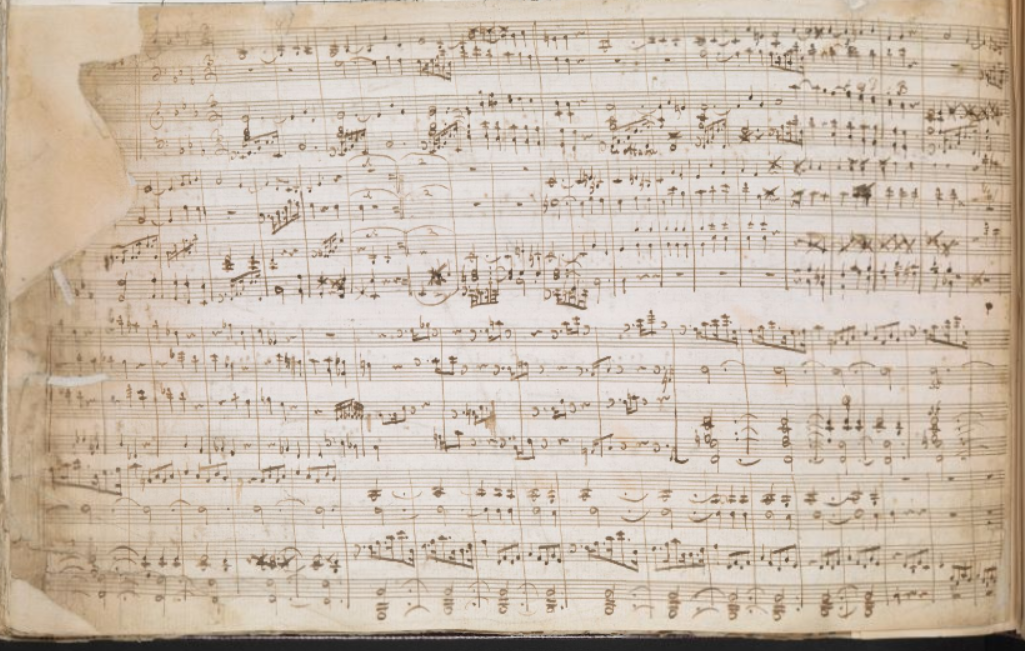
In the fall of 1808 when Beethoven began writing his two Piano Trios, op. 70, he was living in rooms generously furnished to him by Countess Marie Erdödy. (For more background about their relationship see the notes for the Cello Sonata above.) Beethoven participated in the first performance of the Opus 70 Trios at Countess Erdödy’s home around Christmas in 1808, and sent them off to his publisher with a dedication to her. At one point he changed his mind and wished to dedicate them to Archduke Rudolph, but in the end let the dedication to the Countess stand.
It had been ten years since Beethoven had composed his Opus 11 Trio for clarinet (or violin), cello, and piano, and twelve years since he had composed his last major works in the piano trio genre—his three Opus 1 Trios, which had served as his public entrée. By 1808 he was at the pinnacle of his productivity and popularity, and the Opus 70 Trios are surrounded by the masterpieces he presented on that famous marathon concert in December 1808—the Fifth and Sixth Symphonies, the C major Mass, the Choral Fantasy—and equally important works such as his Coriolan Overture and A major Cello Sonata.
The first of the Opus 70 Trios came to be called the “Ghost” because of a comment made after Beethoven’s death about the amazing slow movement. Carl Czerny, Beethoven’s former pupil, wrote in 1842 that the Largo assai ed espressivo “resembles an appearance from the underworld. One could think not inappropriately of the first appearance of the ghost in Hamlet.” The nickname stuck for the entire Trio, and only afterwards it was discovered that Beethoven may have had something supernatural on his mind, because sketches for this movement appear near those for a Witches’ Chorus for a projected Macbeth opera.
The forthright unison opening of the first movement sounds almost as if Beethoven derived it from the first movement of the his Piano Sonata, op. 10, no. 3, and injected it with new energy. He contrasts this immediately with a sweeter phrase begun by the cello. Beethoven allows himself an expansive development section with quite a bit of counterpoint after his extremely concise exposition. The tranquil coda relies on his sweet second phrase until a bright recall of the opening idea ends the movement.
The celebrated “Ghost” movement is one of those marvels that fired the Romantic imagination with its alternating-repeating fragments, plaintive melodic lines, sudden contrasts, agitated tremolos, unsettled harmonies (diminished seventh chords), and above all the eerie floating descents of the piano right hand and rumbling bass notes in the left. As with many of Beethoven’s most startlingly original movements, the overall sonorities mask the quite traditional aspects of his structure, in this case a simple three-part form with coda.
Beethoven opted to return to a three-movement format for this Trio, and hence there is no scherzo. The sonata-form finale returns to the light of day, with a cheerful main theme that keeps halting and digressing. This good-natured meandering flows so naturally that occasional harmonic surprises are swept right along without ceremony. Just before the conclusion, a clever diversion with pizzicato effects, seamless splitting of the melody between the two strings, and piano right-hand glitter gives added urgency to the cadential flourish.
© Jane Vial Jaffe
DMITRI SHOSTAKOVITCH | Piano Quintet
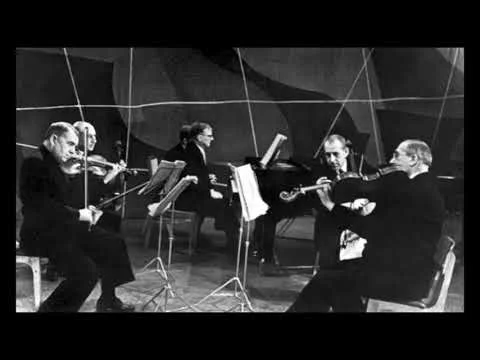
The Piano Quintet in G minor was composed in 1940, following extensive work on two large-scale projects – the Sixth Symphony Op 54 and the re-orchestration of Mussorgsky’s Boris Godunov Op 58. The Quintet was first performed on 23 November 1940 by the Beethoven Quartet and Shostakovich himself. The composition was awarded a Stalin Prize of 100,000 roubles. A glance at the list of movements might lead one to imagine that this is a neoclassical work, but its direct emotional power and thematic integration place it on altogether a higher level than mere pastiche. The piano begins the Quintet, lento, with a solo packed with a tiny three-note cell that can be traced all through the work – this is nothing more than the first three notes of the tonic minor scale. The tone colour of the first entry of the strings is also noteworthy, for it is the cello that is heard above the other instruments. A full close leads to the poco più mosso in 3/8, beginning as a duo for piano and viola. As the other instruments gradually join in, a crescendo leads to the concluding section, lento. In the closing bars G major is touched upon, but is not firmly established as a new region in its own right.
The second movement is a four-voiced fugue beginning with a strict exposition by the muted strings in this order: violin I, violin II, cello, viola. The subject’s answer is tonal, and the fugue continues with the entry of the piano, which almost paradoxically reduces the texture to two lines, reverting to four later. Towards the end of the fugue G major is again tentatively established, but this time by its first inversion – which has B as the root. This subtle point leads directly to the B major tonality of the central movement, the whirlwind Scherzo. This is the first occasion all five instruments have played together for an extended passage in the Quintet, and the central (in classical procedure, the trio) section begins as a danse macabre from first violin, taken up by the piano in high octaves. A reprise of the scherzo leads to a breathless coda.
The Intermezzo is cool and relaxed, with unhurried and essentially single-line music over a gentle walking bass. This builds into a fine and impassioned climax which dies away, finally leaving Ds separated by six octaves. At last, the deep tonal plan of this masterpiece becomes clear: D both completes the major triadic endings of the movements (G, B and now D), implying the final major mode, and is also the classical dominant of G, in which major key the Finale follows, attacca, stealing in with a gentle piano theme, itself having grown thematically from the intial germinal ideas. As the movement progresses, other ideas are recalled, and the music now smiles rather than laughs until, in the closing bars, the Quintet ends gently but swiftly in a complaisant G major.
from notes by Robert Matthew-Walker © 2004